A coin has two sides !
Advantages :
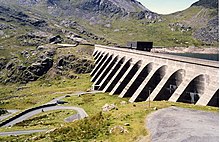 |
| The Stiffening Power Station can generate 360 MW of electricity within 60 seconds of the demand arising. |
|
|
Flexibility
Hydropower is a flexible source of electricity since stations can be ramped up and down very quickly to adapt to changing energy demands. Hydro turbines have a start-up time of the order of a few minutes. It takes around 60 to 90 seconds to bring a unit from cold start-up to full load; this is much shorter than for gas turbines or steam plants. Power generation can also be decreased quickly when there is a surplus power generation. Hence the limited capacity of hydropower units is not generally used to produce base power except for vacating the flood pool or meeting downstream needs. Instead, it serves as backup for non-hydro generators.Low power costs
The major advantage of hydroelectricity is elimination of the cost of fuel. The cost of operating a hydroelectric station is nearly immune to increases in the cost of fossil fuels such as oil, natural gas or coal, and no imports are needed. The average cost of electricity from a hydro station larger than 10 megawatts is 3 to 5 U.S. cents per kilowatt-hour.Hydroelectric stations have long economic lives, with some plants still in service after 50–100 years. Operating labor cost is also usually low, as plants are automated and have few personnel on site during normal operation.
Where a dam serves multiple purposes, a hydroelectric station may be added with relatively low construction cost, providing a useful revenue stream to offset the costs of dam operation. It has been calculated that the sale of electricity from the Three Gorges Dam will cover the construction costs after 5 to 8 years of full generation.[27] Additionally, some data shows that in most countries large hydropower dams will be too costly and take too long to build to deliver a positive risk adjusted return, unless appropriate risk management measures are put in place.
Suitability for industrial applications
While many hydroelectric projects supply public electricity networks, some are created to serve specific industrial enterprises. Dedicated hydroelectric projects are often built to provide the substantial amounts of electricity needed for aluminium electrolytic plants, for example. The Grand Coulee Dam switched to support Alcoa aluminium in Bellingham, Washington, United States for American World War II airplanes before it was allowed to provide irrigation and power to citizens (in addition to aluminium power) after the war. In Suriname, the Brokopondo Reservoir was constructed to provide electricity for the Alcoa aluminium industry. New Zealand's Manapouri Power Station was constructed to supply electricity to the aluminium smelter at Tiwai Point.Reduced CO2 emissions
Since hydroelectric dams do not burn fossil fuels, they do not directly produce carbon dioxide. While some carbon dioxide is produced during manufacture and construction of the project, this is a tiny fraction of the operating emissions of equivalent fossil-fuel electricity generation. One measurement of greenhouse gas related and other externality comparison between energy sources can be found in the ExternE project by the Paul Scherrer Institute and the University of Stuttgart which was funded by the European Commission. According to that study, hydroelectricity produces the least amount of greenhouse gases and externality of any energy source. Coming in second place was wind, third was nuclear energy, and fourth was solar photovoltaic. The low greenhouse gas impact of hydroelectricity is found especially in temperate climates. The above study was for local energy in Europe; presumably similar conditions prevail in North America and Northern Asia, which all see a regular, natural freeze/thaw cycle (with associated seasonal plant decay and regrowth). Greater greenhouse gas emission impacts are found in the tropical regions because the reservoirs of power stations in tropical regions produce a larger amount of methane than those in temperate areas.Other uses of the reservoir
Reservoirs created by hydroelectric schemes often provide facilities for water sports, and become tourist attractions themselves. In some countries, aquaculture in reservoirs is common. Multi-use dams installed for irrigation support agriculture with a relatively constant water supply. Large hydro dams can control floods, which would otherwise affect people living downstream of the project.Disadvantages:
 |
|
The Hoover Dam in the United States
is a large conventional dammed-hydro facility, with an installed capacity of 2,080 MW.
|
 |
|
Hydroelectric power
stations that use dams
would submerge large areas of land due to the requirement of a reservoir. Merowe Dam
in Sudan.
|
Ecosystem damage and loss of land
Hydroelectric projects can be disruptive to surrounding aquatic ecosystems both upstream and downstream of the plant site. Generation of hydroelectric power changes the downstream river environment. Water exiting a turbine usually contains very little suspended sediment, which can lead to scouring of river beds and loss of riverbanks. Since turbine gates are often opened intermittently, rapid or even daily fluctuations in river flow are observed.
Siltation and flow shortage
When water flows it has the ability to transport particles heavier than itself downstream. This has a negative effect on dams and subsequently their power stations, particularly those on rivers or within catchment areas with high siltation. Siltation can fill a reservoir and reduce its capacity to control floods along with causing additional horizontal pressure on the upstream portion of the dam. Eventually, some reservoirs can become full of sediment and useless or over-top during a flood and fail.Changes in the amount of river flow will correlate with the amount of energy produced by a dam. Lower river flows will reduce the amount of live storage in a reservoir therefore reducing the amount of water that can be used for hydroelectricity. The result of diminished river flow can be power shortages in areas that depend heavily on hydroelectric power. The risk of flow shortage may increase as a result of climate change. One study from the Colorado River in the United States suggest that modest climate changes, such as an increase in temperature in 2 degree Celsius resulting in a 10% decline in precipitation, might reduce river run-off by up to 40%.Brazil in particular is vulnerable due to its heavy reliance on hydroelectricity, as increasing temperatures, lower water flow and alterations in the rainfall regime, could reduce total energy production by 7% annually by the end of the century
Methane emissions (from reservoirs)
Lower positive impacts are found in the tropical regions, as it has been noted that the reservoirs of power plants in tropical regions produce substantial amounts of methane. This is due to plant material in flooded areas decaying in an anaerobic environment, and forming methane, a greenhouse gas. According to the World Commission on Dams report, where the reservoir is large compared to the generating capacity (less than 100 watts per square metre of surface area) and no clearing of the forests in the area was undertaken prior to impoundment of the reservoir, greenhouse gas emissions from the reservoir may be higher than those of a conventional oil-fired thermal generation plant.In boreal reservoirs of Canada and Northern Europe, however, greenhouse gas emissions are typically only 2% to 8% of any kind of conventional fossil-fuel thermal generation. A new class of underwater logging operation that targets drowned forests can mitigate the effect of forest decay.
Relocation
Another disadvantage of hydroelectric dams is the need to relocate the people living where the reservoirs are planned. In 2000, the World Commission on Dams estimated that dams had physically displaced 40-80 million people worldwide.Failure risks
During Typhoon Nina in 1975 Banqiao Dam failed in Southern China when more than a year's worth of rain fell within 24 hours. The resulting flood resulted in the deaths of 26,000 people, and another 145,000 from epidemics. Millions were left homeless.
The creation of a dam in a geologically inappropriate location may cause disasters such as 1963 disaster at Vajont Dam in Italy, where almost 2,000 people died.
The Malpasset Dam failure in Fréjus on the French Riviera (Côte d'Azur), southern France, collapsed on December 2, 1959, killing 423 people in the resulting flood.
Smaller dams and micro hydro facilities create less risk, but can form continuing hazards even after being decommissioned. For example, the small Kelly Barnes Dam failed in 1977, causing 39 deaths with the Toccoa Flood, twenty years after its power station was decommissioned the earthen embankment dam failed.
Comparison with other methods of power generation
Hydroelectricity eliminates the flue gas emissions from fossil fuel combustion, including pollutants such as sulfur dioxide, nitric oxide, carbon monoxide, dust, and mercury in the coal. Hydroelectricity also avoids the hazards of coal mining and the indirect health effects of coal emissions. Compared to nuclear power, hydroelectricity construction requires altering large areas of the environment while a nuclear power station has a small footprint, and hydro-powerstation failures have caused tens of thousands of more deaths than any nuclear station failure. The creation of Garrison Dam, for example, required Native American land to create Lake Sakakawea, which has a shoreline of 1,320 miles, and caused the inhabitants to sell 94% of their arable land for $7.5 million in 1949.Compared to wind farms, hydroelectricity power stations have a more predictable load factor. If the project has a storage reservoir, it can generate power when needed. Hydroelectric stations can be easily regulated to follow variations in power demand.

Comments
Post a Comment